


Authors: Risav Pokhrel, Naveena Manogaran
A classical computer performs operations using classical bits. Bits are the smallest possible unit of digital information: zero or one, off or on, false or true, or low or high.
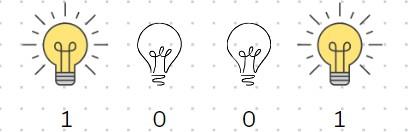
How does turning on and off transmit information? Consider Morse code; it only uses dots and dashes, yet we can still transmit information. Another example would be the digits from zero to nine, which can be used to form other numbers. Similarly, bits with zeros and ones can be used to transmit information. Bits use both of these ideas to represent data. You can find more about this on our GitHub.
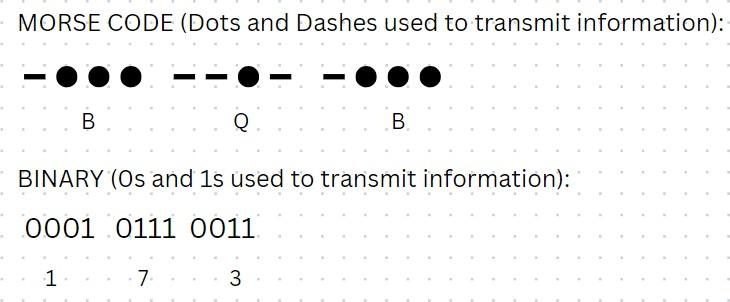
When we apply quantum phenomena to the idea of classical bits, we obtain quantum bits or qubits, for short. These exist in a superposition of states zero and one, which serves as the basis for the possible states of the qubits. Let’s take an elementary example to understand the presence of other states.
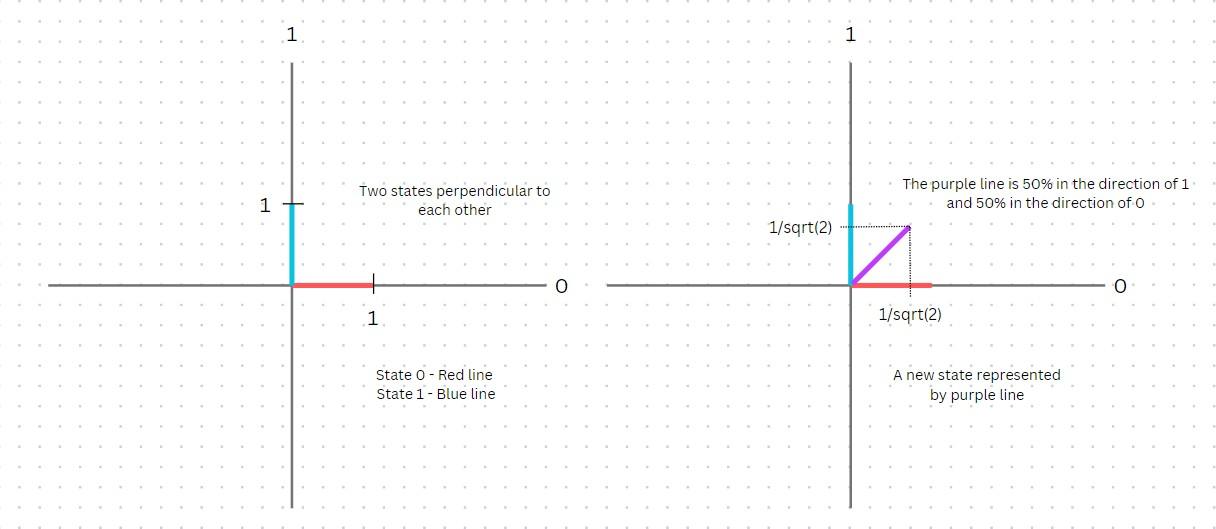
In the above image, the first plot represents the two basis states that we already know: zero and one. In the second plot, we can see a third state, which can be represented with the help of basis states. The third state is described as
What does this mean? Mathematically, the new state has a magnitude of 1/√2 (approximately 0.707) in the direction of 0 and 1/√2 in the direction of 1, which means that the probability of measuring the qubit as 0 is 50% and as 1 is 50%. This property of qubits to have multiple states, which can be described with the basis states, is called superposition.
This property allows quantum computers to be superior in solving certain problems. Of course, an actual qubit is much more complicated than the 2D diagram. Since physical systems exist in a 3D space. To learn more about this, check out our notebook on the Bloch sphere and quantum states
Various physical systems can serve as qubits, including single photons and electrons. But how can we use atoms and photons as qubits? That’s what we will explore in this article. Each atom has a ground state and an excited state. For simplicity, let us take the hydrogen atom with a single electron.
Under no influence of external energy, the electron is in the ground state (Low energy). The electron can also be in a one state, the excited state (Higher energy). In the classical system, our hydrogen atom would be either in the ground state OR the excited state – never both at once. But quantum mechanics allows the electron to exist in a ’superposition’ of both the ground state (0) AND the excited state (1). This isn’t simply flickering between states quickly; the electron truly exists in a mathematical combination of both states at once: α |0⟩ + β |1⟩.
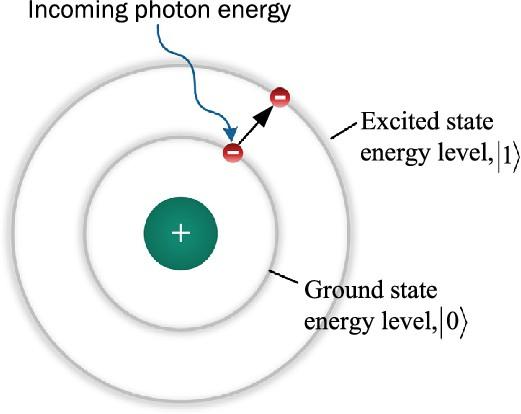
These coefficients (α2, β2) indicate the relative probability of finding the electron in one state or the other. For example, an electron might be in a state that is 70 % ground state and 30 % excited state (✓7/10 |ground⟩ + ✓3/10 |excited⟩) or it could be in an equal 50-50 superposition of both states (1/√2 |ground⟩ + 1/√2 |excited⟩).
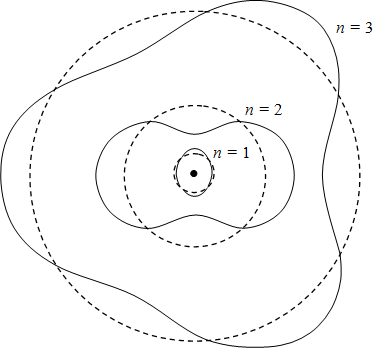
For visualizing the Probabilistic wave nature of the electron, you can run the ”Young’s double slit experiment” simulator on our GitHub.
With a single qubit system, it’s hard to imagine the incredible power of quantum computing. Let’s consider an example of a two-qubit quantum system: A helium atom. These atoms
have four possible states, similar to a two-bit classical system, which can be represented as 00, 01, 10, and 11. However, the key point is that it still holds only two bits of information; we just need to determine the values of the lower and higher bits. A practical system would be a helium atom with two electrons. 00 state means that both electrons are in the ground state. 01 means that one is in the ground state, and the other electron is in the excited state. Similarly, for the remaining two states.
Here’s the catch: Quantum mechanics allows for the superposition of all four states. This means that we can express the system as a superposition of 00, 01, 10, and 11, written as:
α |00⟩ + β |01⟩ + γ |10⟩ + δ |11⟩
To determine the state of these two atoms, classically, we only need 2 bits. But in the above system of two qubits, we need to have four numbers, four coefficients, to describe the state of the system. So, this is how two qubits have 4 bits of information. If we take 3 atoms (qubits), then we would have 8 bits of information. With increasing qubits (atoms), we would have 2N bits of information.
However, even though the qubit can exist in a superposition of states, when it is measured, it falls into one of the basis states, i.e., its wave collapses. And all the information about the other state before the measurement is lost.
To understand the above statement, let us consider the famous example of a cat being both dead and alive to obtain an intuition. A cat is kept in a box and is closed. We do not know the state the cat is in, i.e, alive or dead. So we can say that it is neither dead nor alive. It is in a superposition of both states. But when we open the box, in other words, measure the system, we find that the cat is either dead or alive. It falls into one of its basic states.
Quantum computers are not a replacement for the Classical system. They are not uni- universally faster. They are faster for special types of calculations, such as Shor’s algorithm, which can find the factor of large numbers. One should understand that Quantum Computers are not universal. Quantum computers cannot replace classical computers. It should be used in conjunction with the classical ones.
Explore the code yourself
🔗 GitHub Repository – Double slit experiment simulator
🔗 GitHub Repository – What are qubits?
Feel free to experiment, modify, and run the code to deepen your understanding.